
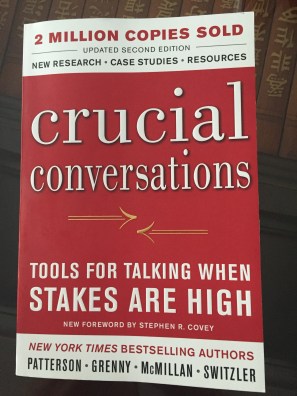
I recently finished reading Crucial Conversations by Patterson, Grenny, McMillan, and Switzler. I strongly recommend this book for everyone as it provides practical strategies and advice on how to handle, approach, and get through difficult conversations. On a daily basis we engage in conversations and sometimes these conversations turn crucial (the authors describe crucial conversations as high stakes, strong emotions, and opposing opinions).
Before getting into specifics about the book, my big take-away from this read is that building positive relationships is key to having successful dialogue and conquering crucial conversations. How we initially approach and further react during crucial conversations depends on us and our own willingness to maintain mutual respect and understanding even when emotions are high and difficult things are being said. The authors describe it perfectly when they state that during crucial conversations it is imperative to ask what you really want from the conversation for yourself, others, and the relationship.
In the final chapter they summarize the book into seven principles. Using their writing as the framework, here is my interpretation on crucial conversations and how it applies to my daily life and work.
- Start with Heart! In every conversation, I must focus on what I really want (in education, the focus is always on what is best for children and maintaining a positive and respectful relationship with others) and make sure that my actions and words are sincere and have the best intentions.
- Learn to Look! It is critical to listen intently and look for when the conversation becomes crucial. Although different for everyone, this is the moment when I might feel threatened or have the instinct to regress and become silent or lash out with accusations and threats. If I can learn to recognize this moment, I do believe that I can take practical steps to control the emotions and positively move forward.
- Make It Safe! This is when it is important to apologize when appropriate and try to fix any misunderstandings. Although it is important during crucial conversations that all people involved take steps to make it safe, the reality is that I can only control myself and thus I need to help restore and establish mutual purpose and respect during these difficult times.
- Master My Stories! During crucial conversations, we all conjure up and tell stories to match our perspective and point of view. At this point, it is imperative that I separate the facts from the story and make sure that I am moving towards what I really want. I must own up to my role in the problem/situation and then tell the rest of the story.
- STATE My Path! In order to open myself up to the views of others, talk about the real issues, and confidently express my own views, I must: Share my facts, Tell my story, Ask for others’ paths, Talk tentatively, and Encourage testing.
- Explore Others’ Paths! We all have different perspectives and it is important that all people are able to share their stories and views. As a leader, I must allow for others to share as we move toward agreement and understanding.
- Move to Action! Holding ourselves accountable for how decisions will be made and how we will follow up, will largely determine the success of moving through a crucial conversation. If we were able to make our way through all of these steps and come to a consensus, then we need to ensure the appropriate changes were made.
To work through crucial conversations at home and work with family, friends, and colleagues this book is a must read!


Thanks for the recap; I’ll be “listening” to this before my new school year begins. 🙂 Great to have you share awesome resources.
LikeLike